
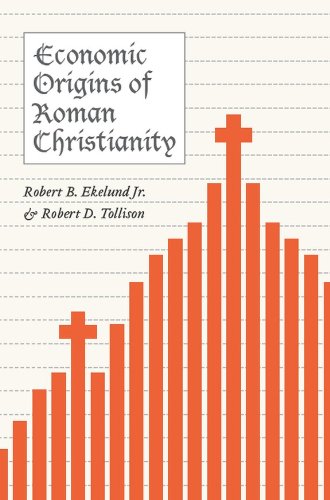
Economic Origins of Roman Christianity
Product details
| Management number | 231932213 | Release Date | 2026/06/18 | List Price | US$19.51 | Model Number | 231932213 | ||
|---|---|---|---|---|---|---|---|---|---|
| Category | |||||||||
In the global marketplace of ideas, few realms spark as much conflict as religion. For millions of people, it is an integral part of everyday life, reflected by a widely divergent supply of practices and philosophical perspectives. Yet, historically, the marketplace has not always been competitive. While the early Common Era saw competition between Christianity, Judaism, and the many pagan cults, Roman Christianity came eventually to dominate Western Europe. Using basic concepts of economic theory, Robert B. Ekelund Jr. and Robert D. Tollison explain the origin and subsequent spread of Roman Christianity, showing first how the standard concepts of risk, cost, and benefit can account for the demand for religion. Then, drawing on the economics of networking, entrepreneurship, and industrial organization, the book explains Christianity's rapid ascent. Like a business, the church developed sound business strategies that increased its market share to a near monopoly in the medieval period. This book offers a fascinating look at the dynamics of Christianity’s rise, as well as how aspects the church’s structure—developed over the first millennium—illuminate a number of critical problems faced by the church today. Read more
| ASIN | B0097E4GWI |
|---|---|
| XRay | Not Enabled |
| ISBN13 | 978-0226200040 |
| Edition | Illustrated |
| Language | English |
| File size | 720 KB |
| Page Flip | Enabled |
| Publisher | University of Chicago Press |
| Word Wise | Enabled |
| Print length | 284 pages |
| Accessibility | Learn more |
| Screen Reader | Supported |
| Publication date | July 5, 2011 |
| Enhanced typesetting | Enabled |
Bestseller ranking
Clinical Chemistry






Customers who viewed this product also viewed
Popes & the Vatican


Correction of product information
If you notice any omissions or errors in the product information on this page, please use the correction request form below.
Correction Request Form